 EN
EN

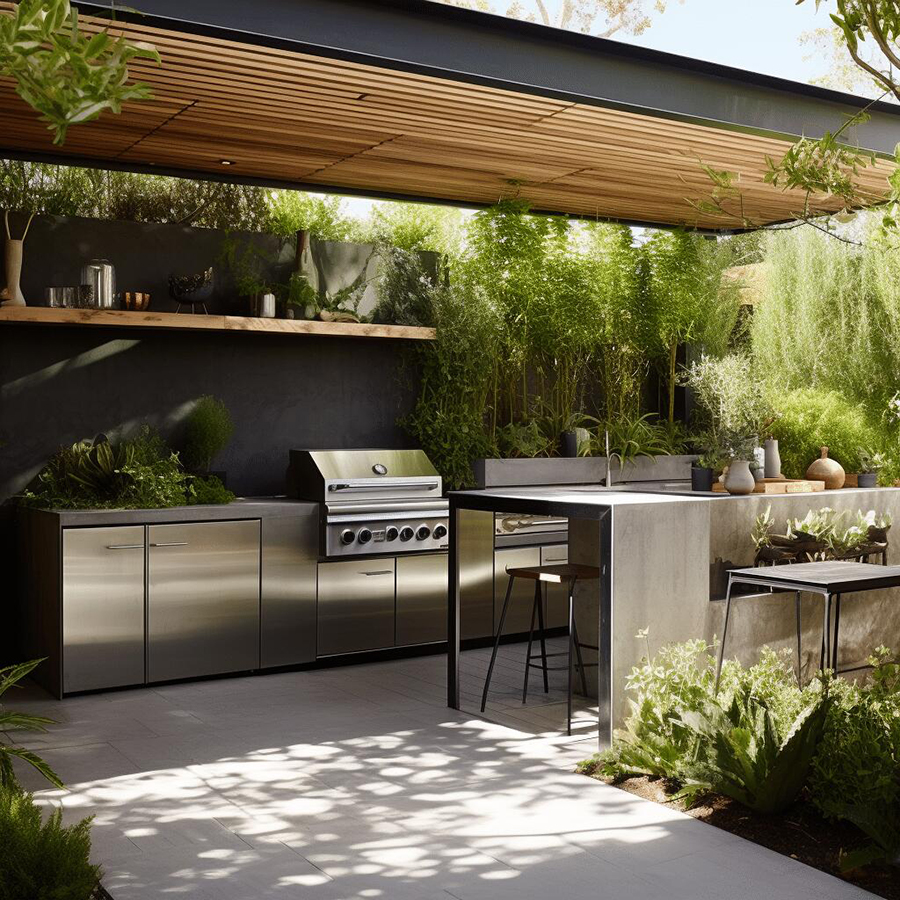
A stainless steel outdoor kitchen should be specified as a complete cabinet and appliance system, not purchased on the material name alone. For a reliable quotation, the project team needs to define the exposure conditions, stainless steel grade, finish, fabrication details, hardware, appliance interfaces and service access before production.
That process matters because two outdoor kitchen cabinets can look similar in a rendering while using different steel grades, sheet thicknesses, fasteners, coatings and construction methods. The right specification depends on where the kitchen will be installed and how it will be used. The checklist below gives designers, contractors and project buyers a practical way to compare proposals.
Start with the installation environment
Do not begin with 304 or 316. Begin with the site.
A covered inland patio, an exposed poolside kitchen and a coastal terrace do not create the same conditions for outdoor kitchen cabinets. Record whether the installation is fully exposed or roofed, how close it is to the sea or a swimming pool, whether wind-driven rain can reach the cabinet, and how the area will be cleaned. Irrigation water, salt spray, chlorinated pool water, smoke, grease and cleaning chemicals can all affect maintenance requirements.
The site review should also identify drainage slopes, standing-water risks and the direction of prevailing weather. A roof reduces direct rain and sun, but it does not remove humidity, airborne salt or the need for ventilation around cooking equipment. This is why the exposure description should appear in the request for quotation rather than being discussed after the stainless steel outdoor kitchen has been ordered.
Compare 304 and 316 as project choices
The search for 304 vs 316 stainless steel is useful only when it is connected to the installation conditions. Both grades are widely used for fabricated stainless steel products, but 316 is commonly considered where chloride exposure is a stronger concern. That does not make every 316 cabinet automatically suitable for every coast, nor does it make 304 unsuitable for every outdoor project.
Use the following comparison as a specification prompt, then ask the supplier to confirm the actual grade in the quotation and material documentation.
Decision factor |
304 stainless steel |
316 stainless steel |
Typical project discussion |
General outdoor and covered applications |
Higher chloride, salt-air or poolside exposure |
Main tradeoff |
Commonly specified and generally more economical |
Usually carries a material cost premium |
What to verify |
Grade certificate, exposed faces, hidden components and maintenance plan |
Grade certificate, whether all relevant parts use 316, and maintenance plan |
What the grade does not settle |
Finish quality, fabrication, drainage, fasteners and cleaning |
Finish quality, fabrication, drainage, fasteners and cleaning |
For either option, request a mill certificate or material test report when the grade is a contractual requirement. Stainless steel grades cannot be confirmed reliably from color or a product photograph. The quotation should also state whether the named grade applies to cabinet boxes, doors, drawers, worktops, internal frames, fasteners and hardware, or only to selected visible parts.
Specify the finish and coating system
The finish changes appearance, cleaning behavior and the way surface marks are seen. A brushed finish is common for stainless steel outdoor kitchen cabinets because its directional grain gives the surface a controlled visual texture. The grain direction should be consistent across adjacent doors and drawer fronts. Polished surfaces can look brighter but may show reflections, fingerprints or fabrication marks differently.
Powder-coated stainless steel adds color and can change the maintenance strategy, but powder coated is not a complete specification. Confirm the substrate grade, surface preparation, coating supplier or system, color reference, gloss level, texture, curing process, outdoor-use suitability and repair method for damaged edges. Ask for a physical finish sample before approving a large run. A competitor's coating warranty or test result does not transfer to another supplier or project.
Where exposed stainless steel is selected, agree on the cleaning method and acceptable visual variation. Where a coating is selected, decide which surfaces are coated and which remain exposed. The finish schedule should distinguish cabinet fronts, side panels, internal parts, worktops and appliance trim.
Check the fabrication details, not only the steel name
Material grade is only one line in a stainless steel outdoor kitchen specification. The fabrication drawing should make the following details visible:
Sheet thickness, including whether the figure refers to the base sheet or the finished assembly.
Folded edges, hemmed edges or exposed cut edges at doors, drawers and access panels.
Weld locations, seam treatment and the expected visible finish after grinding or polishing.
Cabinet feet, plinths or supports and how they keep the cabinet clear of standing water.
Drainage paths and openings that prevent water from being trapped inside a cabinet base.
Fastener, hinge, runner and handle materials, especially where dissimilar metals may meet.
Door gaps, seals and ventilation openings around appliances or gas storage.
Removable panels for valves, electrical connections, drains and future service.
Outdoor kitchen cabinets also need stable alignment after transport and installation. Confirm how modules connect, how end panels are finished and which adjustments can be made on site. For a long cabinet run, agree on joint locations before production so that seams do not conflict with appliances, sinks or prominent sight lines.
Lock appliance interfaces before fabrication
The grill, refrigerator, ice maker, sink, faucet and other equipment should be selected before the cabinet drawings are approved. Each appliance can affect cut-out dimensions, support, ventilation, access, utilities and clearances. Use the manufacturer's current installation manual for the exact model; do not apply a generic clearance copied from another outdoor kitchen.
Send the appliance schedule with model numbers, fuel type and technical drawings. Mark water, drainage, gas and electrical points on the site plan. The cabinet drawing should show how each connection remains accessible after the appliance and countertop are installed.
This interface review is one of the clearest differences between a product image and a buildable stainless steel outdoor kitchen. A cabinet supplier can coordinate openings and panels, but the equipment manufacturer and local trades still control model-specific installation and code requirements.
Decide between modular and custom delivery
A modular stainless steel outdoor kitchen can simplify selection when standard cabinet widths match the site and appliance range. It can also make future replacement easier because the layout is based on repeatable units. The tradeoff is less flexibility around unusual walls, columns, utility points or non-standard equipment.
A custom system is more appropriate when the project has fixed architectural dimensions, integrated end panels, special storage, multiple finishes or equipment that does not fit standard modules. Custom production still benefits from modular thinking: divide the run into transportable units, define connection points and identify which work must be completed on site.
Send a complete RFQ package
For comparable quotations, send every supplier the same information:
1、Project location and exposure description, including coast, pool, roof and prevailing weather.
2、Dimensioned plan, elevations and site photographs.
3、Required stainless steel grade and the parts to which it applies.
4、Finish or powder-coating specification, with color and texture references.
5、Appliance schedule, model numbers and installation manuals.
6、Sink, faucet, drainage, gas and electrical information.
7、Cabinet list with drawers, doors, shelves, waste storage and service panels.
8、Countertop material, thickness, edge and cut-out responsibilities.
9、Delivery access, module size limits and installation responsibility.
10、Required samples, material certificates, shop drawings and approval stages.
Ask suppliers to list exclusions and alternatives rather than hiding them inside a general description. This makes it easier to compare outdoor kitchen cabinets on the same basis and prevents an attractive rendering from substituting for a technical scope.
Sunrise Furnishing provides project-based stainless steel outdoor kitchen sets and other outdoor garden BBQ cabinet configurations. For layout inspiration, see the existing guide to stainless steel outdoor BBQ cabinet ideas. To discuss a new project, contact Sunrise Furnishing with the site conditions, drawings, appliance schedule and preferred finish so the specification can be reviewed before quotation.