 EN
EN

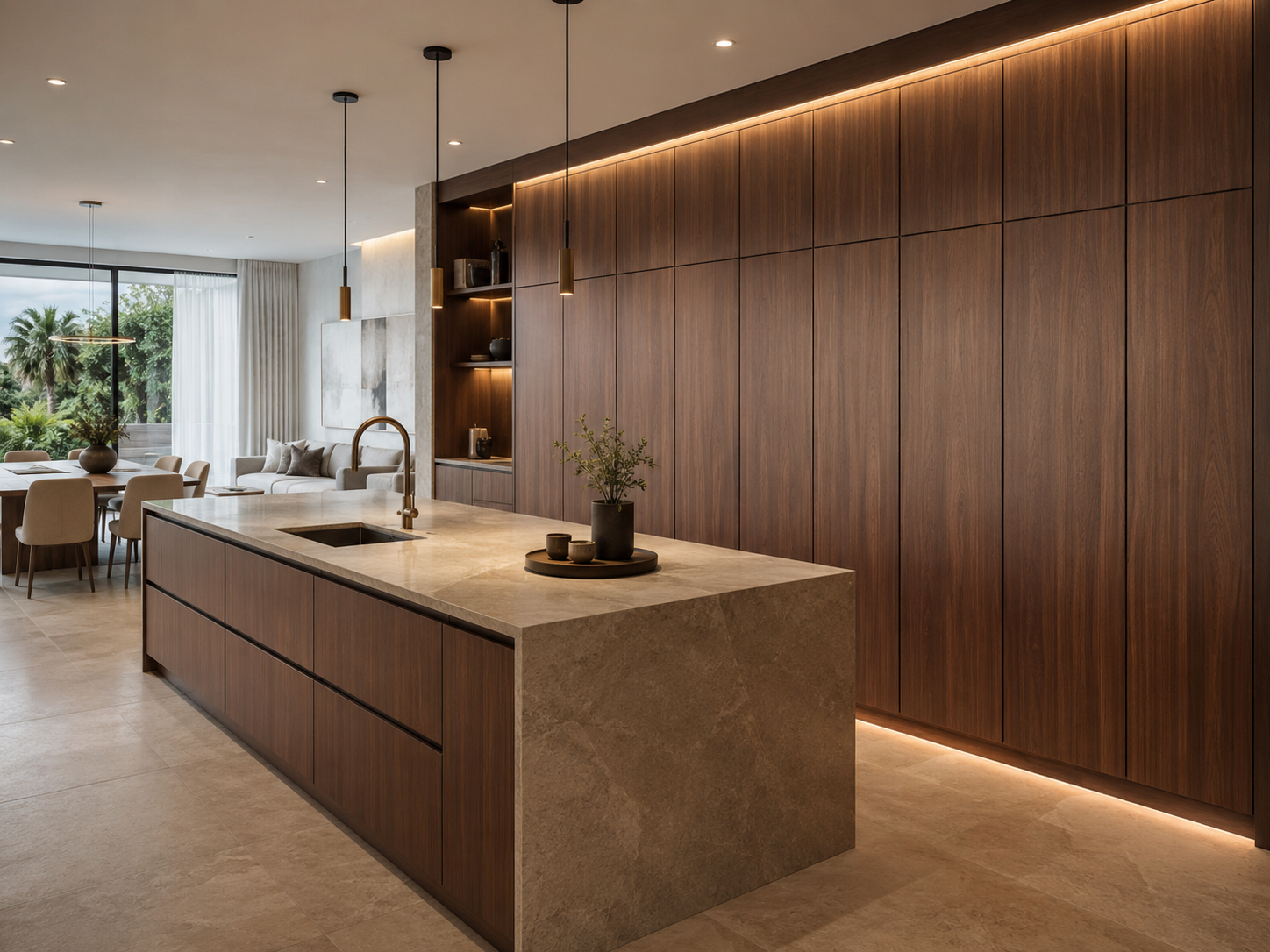
Open kitchens are beautiful because they connect cooking, dining, and living areas into one open space. But this also means that food packages, jars, small appliances, and daily kitchen items can easily become part of the view. That is why many homeowners and designers look for hidden pantry cabinet ideas for open kitchens: they want practical storage without making the kitchen feel busy or visually crowded.
A hidden pantry cabinet is not just a larger cupboard. When planned well, it can work as a pantry wall, an appliance station, a breakfast zone, or a compact storage system that blends into the main kitchen cabinets. The key is to design it around real daily use, not only around appearance.
Quick Answer:
A hidden pantry cabinet is a pantry storage area designed to blend into the surrounding kitchen cabinetry. It often uses flush doors, matching panels, pocket doors, or tall pull-out systems to keep food storage and small appliances out of sight in an open kitchen.
Why Hidden Pantry Cabinets Make Sense in Open Kitchens
In an open kitchen, storage is not only a functional issue. It also affects how the whole home feels. A pantry shelf full of cereal boxes, cooking oil, snack bags, and small appliances may be useful, but it can make a modern open-plan space feel less calm.
A hidden pantry cabinet helps solve this problem by keeping daily storage close to the kitchen while allowing the cabinet front to look clean and integrated.
Keeping food storage out of sight
The most obvious benefit is visual order. Dry food, jars, bottles, pantry baskets, and backup supplies can be stored behind full-height cabinet doors instead of being displayed on open shelves.
This is especially useful in open kitchens connected to a living room or dining room. When guests enter the space, they see a calm cabinet wall rather than a collection of food packaging and appliances.
Creating a cleaner transition between kitchen and living areas
Open kitchens often need to feel like part of the interior design, not just a working kitchen. A hidden pantry cabinet can create a smoother transition between the cooking area and the rest of the home.
For example, a pantry wall finished in the same wood veneer as the kitchen cabinets can look like an architectural feature. In a villa, apartment, or open-plan home, this helps the kitchen feel more intentional and less cluttered.
Supporting daily cooking without visual clutter
A hidden pantry should still be easy to use. The goal is not to hide everything so well that daily cooking becomes inconvenient. The best pantry cabinet designs keep frequently used items at comfortable heights, place heavier items lower, and reserve upper storage for less-used supplies.
A good design balances two needs: a clean view when the doors are closed, and practical access when the doors are open.
Choose the Right Hidden Pantry Layout for Your Kitchen
Different open kitchens need different pantry layouts. A large villa kitchen may have space for a full pantry wall, while a compact apartment kitchen may need a tall pull-out cabinet. Before choosing the style, consider the kitchen size, walking path, island position, appliance needs, and how often the pantry will be used.
Full-height pantry wall for larger open kitchens
A full-height pantry wall is one of the most seamless options for open kitchens. It usually extends from floor to ceiling and can be designed with matching cabinet doors so the pantry looks like part of the main kitchen wall.
This layout works well when the kitchen has enough wall length, needs generous food storage, and requires a clean built-in look. It can also match other tall cabinets, such as oven towers or refrigerator panels.
For villas, large apartments, and open-plan homes, a pantry wall can also become part of the kitchen’s visual identity. However, deep cabinets should be planned carefully. Without pull-out trays, baskets, or internal organization, items at the back can be difficult to reach.
Pocket-door pantry cabinet for appliance and coffee zones
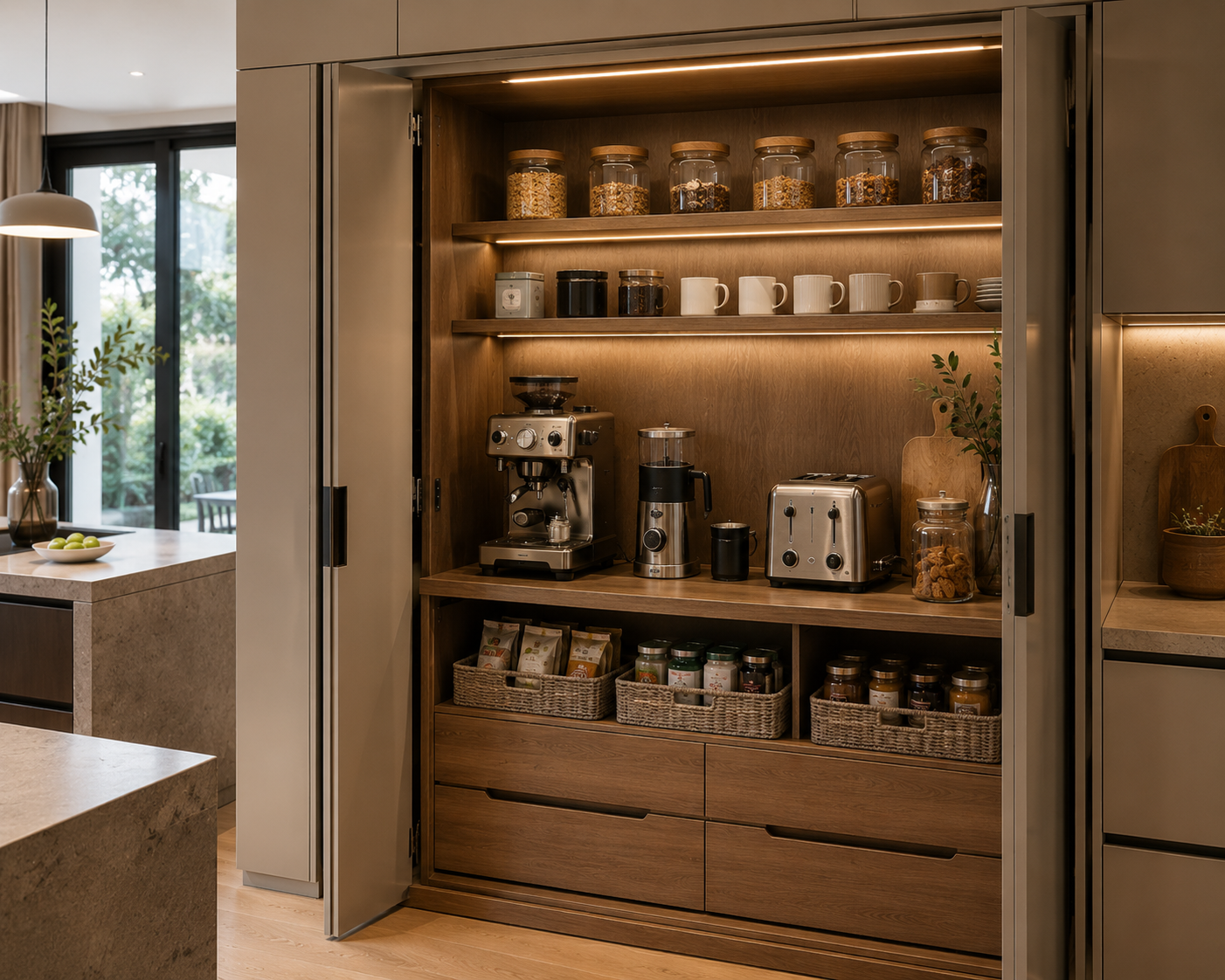
A pocket-door pantry cabinet is useful when the pantry also needs to hold small appliances, a coffee machine, kettle, toaster, or breakfast items. The doors slide back into the cabinet sides, allowing the cabinet to stay open while in use.
This can be a good choice for open kitchens because the cabinet can look clean when closed, but function like a mini breakfast station when open.
Important planning notes include checking the pocket-door hardware quality, allowing enough cabinet depth for appliances and wiring, planning ventilation for heat-generating appliances, and confirming whether appliances should be operated inside the cabinet or only stored there.
Appliance use depends on product instructions, ventilation conditions, and project design. It should not be assumed that every appliance can safely operate inside a closed or semi-closed cabinet.
Tall pull-out pantry cabinet for compact homes
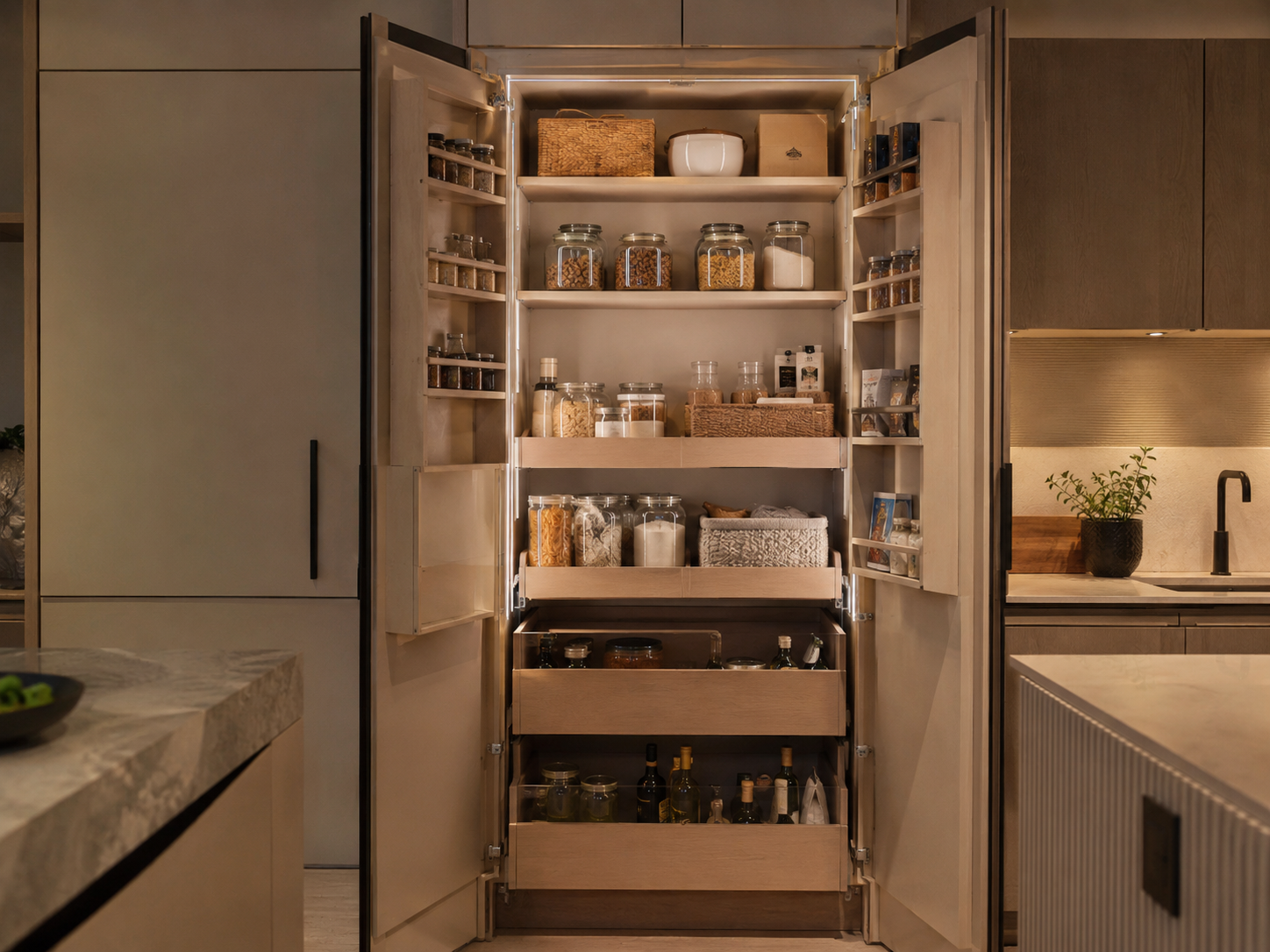
A tall pull-out pantry cabinet is a practical option for smaller kitchens. Instead of opening wide cabinet doors, the entire internal rack pulls forward, making items visible from both sides.
This design is suitable when the kitchen has limited width, needs organized dry food storage, or cannot fit a full pantry wall. It also works well when the pantry is placed near the cooking zone.
Tall pull-outs are useful, but their size and loading capacity should be selected carefully. Heavy jars, bottles, and bulk food items may require stronger hardware. For custom kitchen cabinets, the pull-out system should be chosen based on cabinet dimensions and expected storage weight.
Door Styles That Create a Seamless Cabinet Look
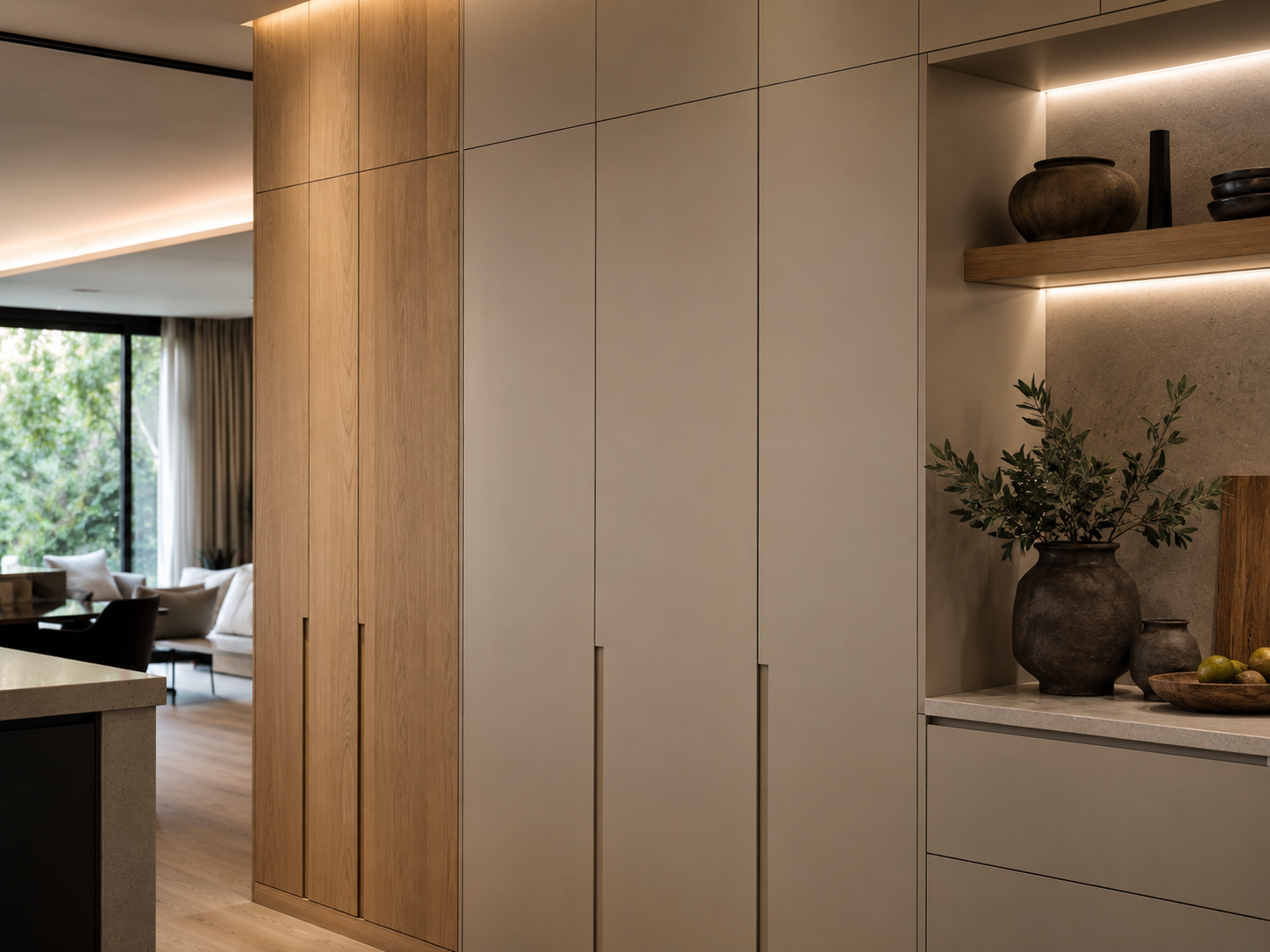
The door style is what makes a pantry “hidden.” Even if the inside is very functional, the exterior should blend with the rest of the kitchen. In open kitchens, cabinet doors are part of the room’s overall design, so the pantry finish should be planned together with the main kitchen cabinets.
Flush doors for a built-in wall effect
Flush cabinet doors create a flat, built-in appearance. They are often used in modern kitchens because they reduce visual lines and make tall storage feel more architectural.
For a hidden pantry, flush doors can help the cabinet wall appear clean and continuous. This is especially effective when the pantry is placed beside a refrigerator panel, oven tower, or full-height storage cabinet.
A detail to check is door alignment. Uneven gaps or poorly aligned panels can make a hidden pantry look less refined. In custom cabinet projects, panel size, hinge position, and installation tolerance should be reviewed before production.
Wood veneer panels for a warmer open kitchen
Wood veneer panels are a good option when the open kitchen needs warmth. They can soften a modern interior and help the pantry wall connect visually with dining furniture, flooring, or living room finishes.
Popular design directions include warm walnut tones for a refined villa kitchen, light oak for a softer modern space, smoked wood veneer for a more dramatic look, and mixed wood with matte lacquer for a balanced two-tone design.
The goal is not simply to use wood, but to coordinate the pantry with the overall interior palette.
Handleless and recessed-pull doors for a minimal look
Handleless doors or recessed pulls can make a pantry cabinet feel more discreet. They remove visible hardware from the cabinet front and help the door panels read as one clean surface.
However, the opening method should be practical. Push-to-open systems may look clean, but in a busy kitchen they can show fingerprints or feel less convenient for heavy pantry doors. Recessed pulls or slim integrated handles may be more comfortable for some projects.
The right choice depends on door size, cabinet weight, user habits, and the desired kitchen style.
Plan the Inside Around Real Daily Use
A hidden pantry cabinet should be planned from the inside out. A beautiful door is useful only if the interior supports daily routines. Before deciding shelf heights and accessories, list what the pantry needs to hold.
Dry food, jars, and pantry baskets
Dry food storage usually includes rice, pasta, cereal, flour, snacks, canned goods, spices, sauces, and packaged items. These products vary in height and weight, so adjustable shelves can make the pantry more flexible.
Clear pantry baskets or divided storage zones can help prevent deep cabinets from becoming messy. For custom cabinets, it is useful to separate daily cooking items, backup food supplies, bottles and sauces, snacks and breakfast items, and less-used seasonal or bulk items.
This makes the pantry easier to maintain over time.
Small appliances that need easy access
Small appliances can make an open kitchen look cluttered if they are always left on the countertop. A hidden pantry cabinet can store appliances such as a toaster, blender, coffee grinder, or mixer when they are not in use.
However, appliance storage needs careful planning. Consider whether the appliance will be used inside the cabinet, whether it produces heat or steam, whether there is enough clearance above and around it, whether power outlets are needed inside the cabinet, and whether the interior surface is easy to clean.
For safety and long-term usability, appliance specifications should be checked before finalizing the cabinet design.
Breakfast, coffee, and drink stations
A breakfast or coffee station is one of the most popular uses for a hidden pantry cabinet. It can hold coffee cups, mugs, tea, cereal, snacks, a coffee machine, and small breakfast appliances in one organized zone.
This works especially well with pocket doors. During the morning, the cabinet can stay open and function as a small service station. After use, the doors close and the kitchen returns to a clean open-plan look.
Materials, Finishes, and Lighting Details to Consider
Materials and finishes affect both appearance and long-term usability. In an open kitchen, the outside of the pantry should match the design language of the room, while the inside should be practical, cleanable, and suitable for kitchen storage.
Moisture-resistant cabinet boards for kitchen use
Kitchens are not the same as dry living rooms. Cabinet materials may be exposed to moisture, cleaning, cooking activity, and temperature changes. Moisture-resistant cabinet boards can be considered for pantry cabinets, especially in areas near cooking zones, sinks, or appliances.
This does not mean the cabinet is completely waterproof. Material performance depends on board type, edge banding, hardware, installation quality, and project conditions. For a custom pantry cabinet, the board specification should be confirmed based on the kitchen environment and budget.
Easy-clean interior surfaces
The inside of a pantry can collect crumbs, powder, oil residue, and packaging dust over time. Easy-clean interior surfaces make maintenance more manageable.
Useful details may include smooth internal panels, adjustable shelves, removable baskets or trays, light-colored interiors for better visibility, and durable edge finishing for frequent use.
If the pantry includes coffee or breakfast appliances, the interior surface should be selected with cleaning and heat awareness in mind.
Interior LED lighting for deep pantry cabinets
Deep pantry cabinets can become dark, especially when they are full-height or placed away from natural light. Interior LED lighting can make the cabinet easier to use and more comfortable for daily routines.
Lighting is especially useful for tall pantry walls, pocket-door appliance stations, coffee or breakfast zones, dark wood veneer interiors, and deep shelves with many small items.
The lighting layout should be planned together with wiring, switches, and cabinet structure. In custom kitchen cabinet projects, this should be confirmed before production rather than added as an afterthought.
Matching pantry finishes with the main kitchen cabinets
A hidden pantry works best when it looks like part of the kitchen system. The door finish, panel thickness, handle style, toe kick, and vertical lines should coordinate with the surrounding cabinets.
This is where custom cabinet planning becomes useful. Instead of treating the pantry as a separate storage unit, it can be designed as part of the full kitchen composition.
Mistakes to Avoid When Designing a Hidden Pantry
Hidden pantry cabinets can be very practical, but small design mistakes may affect daily use. Before confirming the design, it is worth checking how the pantry will work when the doors are open, when the kitchen is busy, and when multiple people use the space.
Common Mistake:
A pantry cabinet should not only look hidden when closed. It also needs to work comfortably when open. Always check door clearance, shelf depth, appliance heat, lighting, and access to daily-use items.
Doors that block the cooking or walking path
Large pantry doors may look simple in drawings, but they can block circulation when opened. This is a common issue in open kitchens with islands, narrow walkways, or nearby dining areas.
Before choosing hinged doors, check whether the door hits the island, whether two people can pass when the pantry is open, whether the door blocks the refrigerator, oven, or sink, and whether pocket doors or sliding systems would work better.
Good pantry design should support movement, not interrupt it.
Deep storage without pull-out hardware
Deep cabinets can store a lot, but they are not always easy to use. Without pull-out trays, baskets, or internal drawers, items at the back can be forgotten.
For larger pantry cabinets, consider combining fixed shelves with pull-out accessories. Frequently used items should be easy to reach, while backup supplies can be stored higher or deeper.
Storing appliances without ventilation planning
A hidden appliance station is convenient, but ventilation should not be ignored. Coffee machines, toasters, kettles, and similar appliances may produce heat, steam, or moisture.
Important details include air clearance around appliances, heat-resistant or easy-clean surrounding surfaces, power outlet placement, whether doors should remain open during use, and manufacturer instructions for each appliance.
Do not assume that a closed cabinet is suitable for operating every appliance. This should be reviewed during the design stage.
When a Custom Hidden Pantry Cabinet Is Worth Considering
A hidden pantry does not always need to be fully custom, especially in a simple kitchen. But for open kitchens where the pantry must match the main cabinet system, a custom design can make the layout more practical and visually consistent.
For villas and large open-plan kitchens
Villas and large open-plan kitchens often need more storage than standard cabinets can provide. A custom pantry wall can combine dry food storage, appliance zones, wine or drink storage, and tall cabinets into one organized composition.
This can help the kitchen feel more integrated with the architecture of the home. It also allows panel sizes, cabinet proportions, and finishes to be planned together.
For compact kitchens that need visual order
Small kitchens can also benefit from hidden pantry cabinets. In compact homes, too many visible items can make the space feel smaller. A tall pull-out pantry or narrow hidden storage column can improve organization without taking up too much floor area.
The key is to avoid overbuilding. A compact hidden pantry should be designed around the items that are truly used every day.
For projects that need matching kitchen cabinet finishes
If the pantry needs to match the kitchen cabinets exactly, custom production may be more suitable. Matching finish, door gaps, hardware, lighting, and cabinet proportions can be difficult when using separate off-the-shelf furniture pieces.
For project clients, designers, or contractors, early coordination helps avoid mismatched finishes and installation problems.
Final Checklist Before You Design a Hidden Pantry Cabinet
Before finalizing a hidden pantry cabinet for an open kitchen, review these points.
Layout checklist
Check whether there is enough wall space for a full-height pantry, whether the pantry will be near the cooking zone, refrigerator, or island, whether the cabinet doors will block circulation when open, and whether hinged doors, pocket doors, or pull-out systems would work better.
Daily-use items should also be placed at comfortable heights, while less frequently used items can be stored higher or deeper inside the cabinet.
Interior storage checklist
List the dry food items, jars, bottles, bulk supplies, snacks, and breakfast products that need to be stored. Then consider whether adjustable shelves, pull-out baskets, internal drawers, or divided zones are needed.
If the pantry will include a breakfast or coffee station, plan that area separately from general dry food storage.
Appliance checklist
Confirm which small appliances will be stored inside the cabinet and whether any of them will be used inside the cabinet. If so, ventilation, power outlets, clearance, heat, steam, and appliance instructions should be reviewed carefully.
Material and finish checklist
Check whether the pantry finish matches the kitchen cabinets, whether the interior surfaces are easy to clean, whether the board type is suitable for kitchen use, and whether edges, hinges, and hardware are appropriate for frequent use.
Interior lighting should also be planned before production, especially for deep pantry cabinets or dark interiors.
Project planning checklist
Cabinet dimensions, door gaps, panel alignment, electrical points, installation conditions, and material samples should be confirmed before production. A hidden pantry cabinet should be planned as part of the kitchen system, not as a separate storage idea added at the end.
FAQ About Hidden Pantry Cabinets
What is a hidden pantry cabinet?
A hidden pantry cabinet is a pantry storage cabinet designed to blend into the surrounding kitchen cabinetry. It may use flush doors, matching panels, pocket doors, or tall pull-out systems to keep food storage less visible in the kitchen.
Is a hidden pantry good for an open kitchen?
Yes, it can be useful for many open kitchens because it helps reduce visual clutter. However, it should be planned around the kitchen layout, walking path, storage needs, and door-opening space.
What door style is best for a hidden pantry?
Flush doors, handleless doors, recessed-pull doors, and matching wood veneer panels are common choices. The best option depends on the kitchen style, cabinet size, door weight, and how often the pantry is used.
Can small appliances be stored inside a hidden pantry?
Yes, small appliances can often be stored inside a hidden pantry cabinet. If they will be used inside the cabinet, ventilation, heat, power outlets, and appliance instructions should be reviewed before finalizing the design.
Should a hidden pantry be custom made?
A custom hidden pantry is worth considering when the pantry needs to match the main kitchen cabinets, fit a specific wall, include appliances, or support a larger open-plan kitchen layout. For simpler kitchens, a standard tall pantry cabinet may also work.
Practical Summary: Designing a Hidden Pantry for a Cleaner Open Kitchen
A hidden pantry cabinet can make an open kitchen feel cleaner, calmer, and easier to organize. The most successful designs are not only about hiding storage. They combine layout planning, door style, interior organization, lighting, material selection, appliance safety, and daily-use habits.
For a large open kitchen, a full-height pantry wall can create a seamless built-in look. For a breakfast or coffee zone, pocket doors may offer a more practical solution. For compact homes, a tall pull-out pantry can provide organized storage without taking up too much space.
If your kitchen project requires matching finishes, custom cabinet dimensions, integrated lighting, appliance storage, or a full open-plan cabinet system, it may be helpful to plan the hidden pantry together with the rest of the kitchen cabinets from the beginning.
Sunrise Furnishing works with custom cabinetry for residential, villa, apartment, hotel, and project spaces. For open kitchen projects, pantry cabinet details such as layout, door panels, internal storage, lighting, and appliance zones should be reviewed based on drawings, project conditions, and installation requirements.
Table of Contents
- Why Hidden Pantry Cabinets Make Sense in Open Kitchens
- Choose the Right Hidden Pantry Layout for Your Kitchen
- Door Styles That Create a Seamless Cabinet Look
- Plan the Inside Around Real Daily Use
- Materials, Finishes, and Lighting Details to Consider
- Mistakes to Avoid When Designing a Hidden Pantry
- When a Custom Hidden Pantry Cabinet Is Worth Considering
- Final Checklist Before You Design a Hidden Pantry Cabinet
- FAQ About Hidden Pantry Cabinets
- Practical Summary: Designing a Hidden Pantry for a Cleaner Open Kitchen